
We Counted the Watts
We forgot to count the waste.

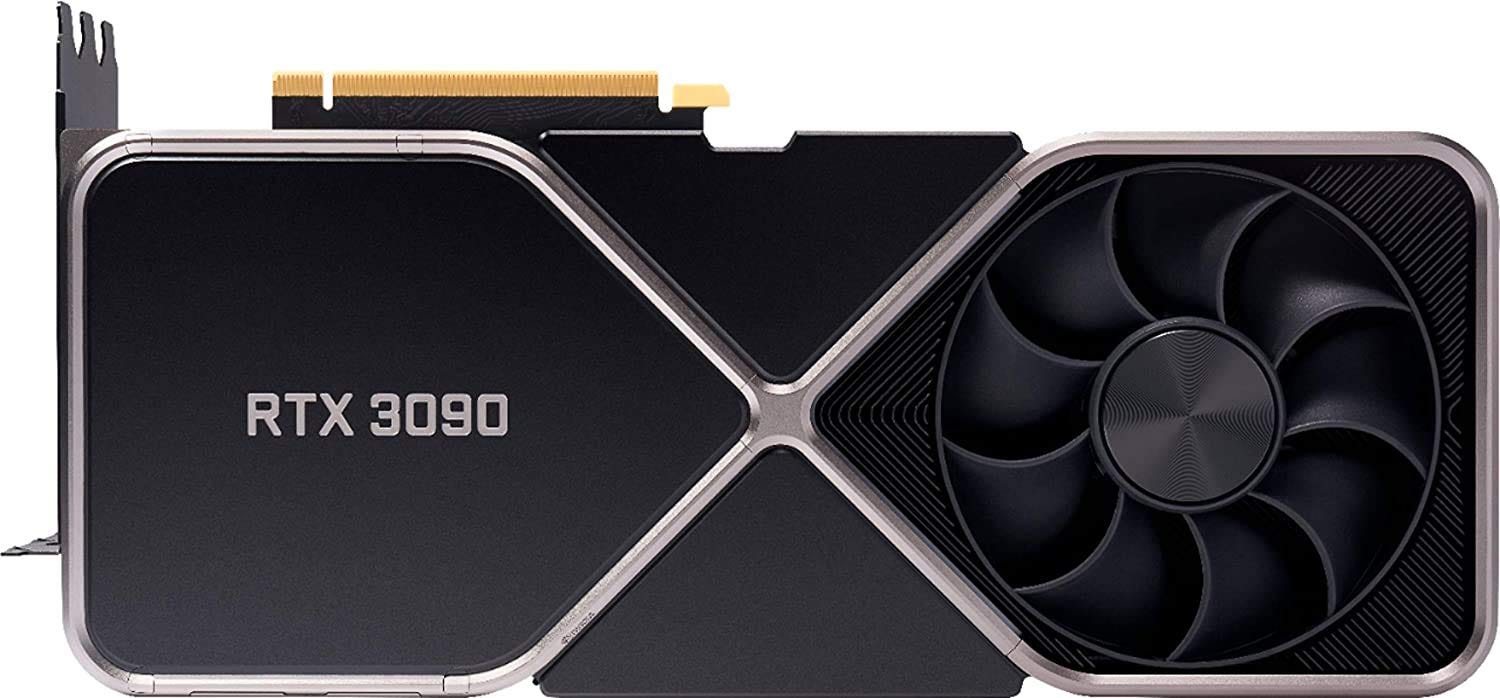
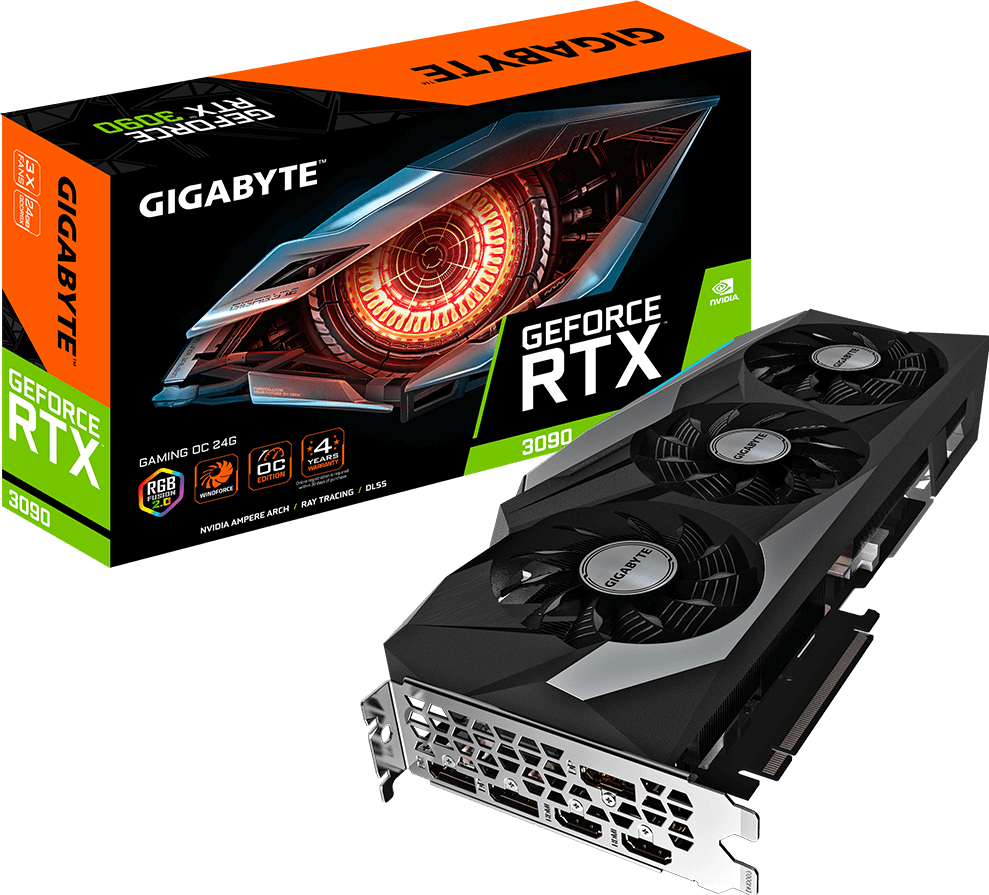
Back in 2021, fresh after rubbing off my YouTube career that never took off, I was putting together a homelab (and oh, if you are wondering whether I was trying to recreate Dexter’s Lab in my house, let me stop you; homelab is this great counter movement of self-hosting various tech services within your house and watch this space for more later) and I had a fairly clear idea of what I needed; something that could run a few local models for some machine learning experimentation, handle a home DVR setup, act as a self-hosted Google Drive equivalent, and generally serve as a personal compute layer that I actually owned and controlled rather than renting from someone else’s cloud at a monthly rate that adds up quietly and consistently. The RTX 3090 was a sufficient choice at the time and a capable card, well-supported and within the range of what a serious hobbyist could justify spending without having to write a business case for themselves. I noted the price, got distracted by other things the way life tends to arrange, and came back to the same research a couple of years later.
O Captain My Captain, was I in for a shock! The price increase meant I had only one kidney remaining, which I would need to forego again for the next generation iPhone.
Exhibit•RTX 3090(3 items)▼
[1/3]RTX 3090 used GPU prices today (2026)
[2/3]RTX 3090 used GPU prices today (2026)

[3/3]RTX 3090 used GPU prices today (2026)
I was perplexed, not just because of the number itself, but the reasoning behind it; neither had the RTX 3090 become faster in the intervening years nor did it acquire new capabilities or a firmware update that made it meaningfully different from the card I had been looking at in 2021. The reason this happened can be attributed to the explosion of local AI inference workloads, the shortage of newer silicon, and the downstream effect of hyperscaler procurement decisions that were rippling all the way down to the secondhand consumer GPU market in India. A card that was already priced at the upper end of the enthusiast market had become a datacentre hand-me-down in high demand, and the price reflected that new identity rather than the hardware’s age.
This stuck me as odd, and it sent me down a rabbit hole that I have not entirely climbed out of since, because the more I looked at how the AI industry actually relates to its own hardware, the more I became convinced that the entire sustainability conversation around AI is looking at the wrong number. We are obsessed with watts and we are counting energy consumption, debating electricity sources, publishing carbon footprints per query, and having genuinely important arguments about whether a datacentre should run on renewables or not. But underneath that conversation, mostly unexamined, is a hardware replacement cycle that may turn out to be the fastest and most wasteful industrial obsolescence machine that the technology industry has ever built, and almost nobody is measuring it.
The Lifespan Nobody Advertises
When you buy a consumer GPU, the assumption baked into the purchase is that the hardware will be useful for a reasonably long time and that its retirement will be driven by your own needs evolving rather than by an externally imposed obsolescence. Enterprise hardware has always worked a little differently, with depreciation schedules and procurement cycles that treat servers as capital assets with defined useful lives, but even there, the assumption has historically been that a server bought today will earn its keep over five or six years before it needs to be replaced.
Legacy Chips in AI Training
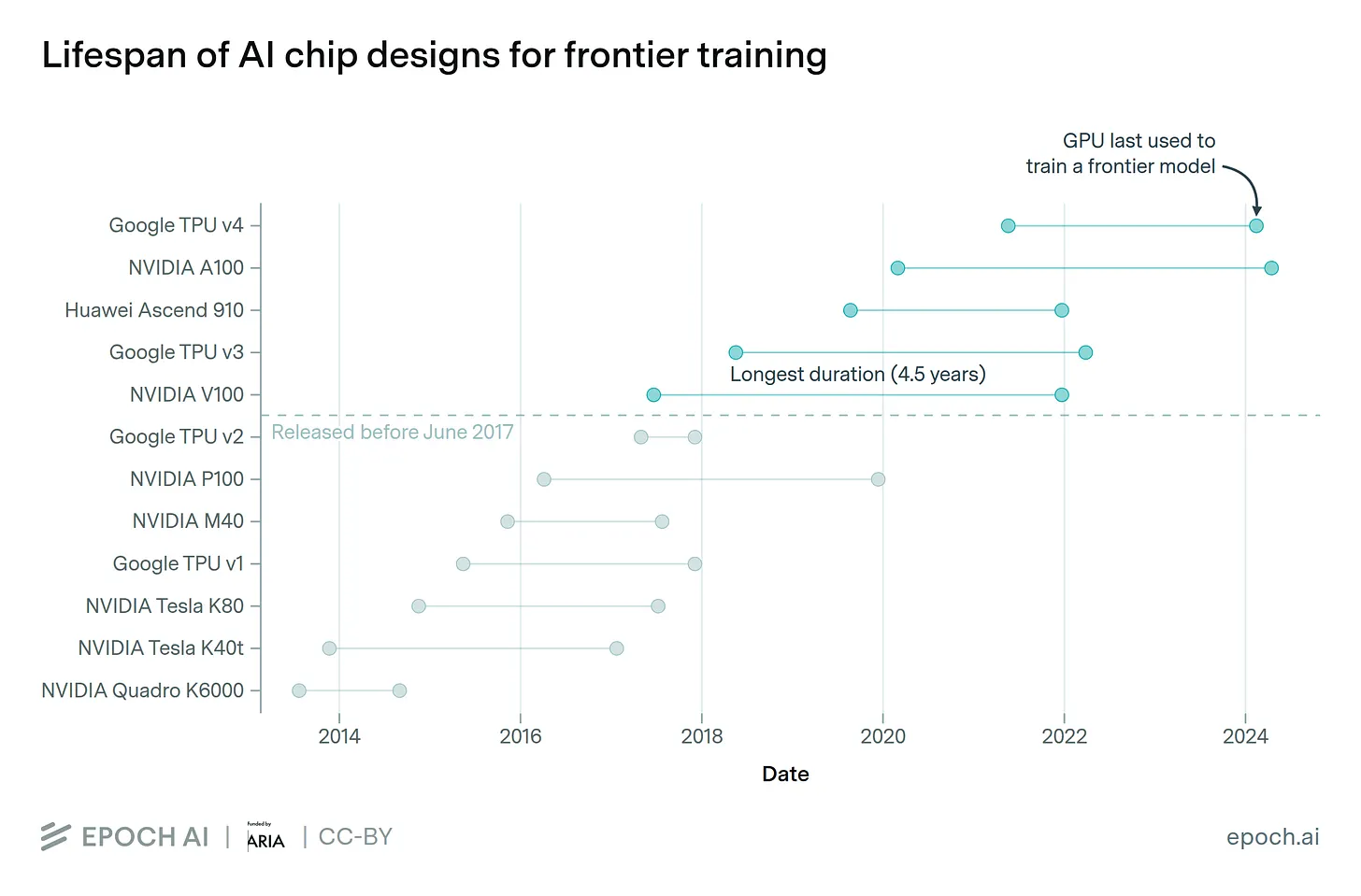
AI accelerators are breaking that assumption in ways that the industry is only beginning to account for now. Datacentre GPUs running at full AI workloads operate at 700 watts or more of sustained power dissipation, which is an enormous amount of thermal stress on a chip over time, and the numbers reflect this reality in ways that should give anyone pause. According to research published by TrendForce, datacenter GPUs used for AI and HPC applications may have an effective operational lifespan of only one to three years under sustained high-utilisation conditions, which is a strikingly short window for hardware that costs tens of thousands of dollars per unit. The typical pattern, according to analysis of AI training infrastructure, involves roughly two years of active training workloads followed by another two years of inference before the hardware reaches economic end of life, with eight-year deployments representing outliers rather than the norm.
Meta’s own published research on training Llama 3 405B offers a particularly candid data point here, wherein the model was trained on a cluster of 16,384 NVIDIA H100 GPUs (yes, you read that right, sixteen thousand+ H100 GPU, one of the legacy but top of the line AI chips), and during that training run, roughly 30% of disruptions were caused by GPU failures and another 17% by High Bandwidth Memory failures, the HBM being the stacked memory architecture that sits directly on the accelerator die within chip and handles the enormous data throughput that large model training demands. If those failure rates hold as a reasonable baseline, the annualised failure rate across a large GPU fleet comes out at approximately 9%, which means that over three years, roughly 27% of the hardware in a large training cluster will have failed outright, to say nothing of the units that remain functional but are economically displaced by newer generations.
Economic Obsolescence Is Not the Same as Technical Failure
This is the part of the conversation that tends to get silenced, because when the hardware does not stop working, once it is past the useful life. NVIDIA’s Blackwell GB200, a latest cutting edge chip in maturity lifecycle (and beaten by GB300 as we speak) delivers four to five times faster inference performance than the H100, which was itself only launched in 2023 but now considered legacy. When players in the hyperscaler ecosystem deploy hardware with that kind of performance differential, three-year-old chips become economically obsolete even if they are physically intact and fully functional. This is because the cost per completed task continuing to run on older hardware stops making financial sense at scale. The jurassic relic A100, launched in 2020 (yeah, a full 6 years ago), can still handle inference and fine-tuning workloads competently and at roughly half the hourly cost of an H100, but the pressure to chase the newest silicon does not come from workload requirements alone, rather from competitive dynamics, investor narratives, and one that of optics, as being seen to run on older hardware is its own kind of liability.
The financial scale of what this means for the industry is only beginning to surface in earnings disclosures and analyst forecasts, and the numbers are striking. Alphabet’s depreciation expenses on AI hardware are projected to reach $28 billion in 2026, against a Wall Street consensus that had estimated $22.6 billion, a gap of more than $5 billion driven almost entirely by faster-than-expected hardware churn. On a similar note, Meta faces an even larger discrepancy, with Barclays forecasting $30.8 billion in depreciation costs against a street estimate of $21 billion, which makes amount like $9 billion difference sound like pocket change (I think I chose the wrong career). One particularly stark analysis of AI datacentres being built in 2025 concluded that they will suffer $40 billion of annual depreciation while generating somewhere between $15 and $20 billion of revenue, meaning the depreciation is literally twice the revenue being generated by the infrastructure.
The hyperscalers like AWS, Google, and Azure all extended their server depreciation schedules from three years to six years between 2020 and 2024, a move that looks like prudent asset management but in practice, it is an earnings smoothing exercise, spreading the cost of hardware over a longer period on paper while the physical replacement cycle continues at its own pace. Then in early 2025, Amazon reversed course and shortened a subset of server useful lives from six years back to five, citing the accelerating pace of AI and machine learning development as the reason. The divergence across the major cloud providers on something as fundamental as how long their hardware lasts is a perfect example of depreciation schedules that are being used as active earnings management levers, not as genuine engineering assessments of how long the hardware actually remains useful.
AI is more of a material science business than software
There is a framing that has always sat a little uneasily with me whenever I hear the AI industry described purely in terms of models, parameters, and algorithmic breakthroughs, which is that none of it exists without a very specific and very finite set of physical materials that took geological timescales to accumulate and that we are consuming at a pace that has no historical precedent in the technology industry.
A single AI accelerator requires cobalt, copper, silicon, and a suite of rare earth elements in quantities and purities that make the supply chain involved genuinely complex, with dependencies that span dozens of countries and hundreds of supplier relationships. Take for example Intel, which operates in more than 100 countries, works with over 450 supplier factories and 16,000 suppliers, and processes over a terabyte of supply chain and manufacturing data every single day. The supply chains of Amazon, Anthropic, Google, Meta, Microsoft, and NVIDIA are of comparable or greater complexity, and the honest assessment of any supply chain at that scale is that no one can credibly claim it is free from conflict, environmental damage, or human exploitation somewhere along the chain. The minerals that make AI possible took millions of years to form, and the current consumption rate, driven by replacement cycles measured in months rather than decades, is not a fact that features prominently in most AI sustainability reports.
Water is another resource that rarely makes the AI environmental conversation in proportion to its actual significance. The combined global water withdrawal of Google, Microsoft, and Meta reached an estimated 2.2 billion cubic metres in 2022, an amount equivalent to the total annual water withdrawal of two Denmarks, covering municipal, industrial, and agricultural usage combined. This is water used for server cooling, electricity generation, and supply chain manufacturing, and it is being consumed at scale in geographies that are already under water stress.
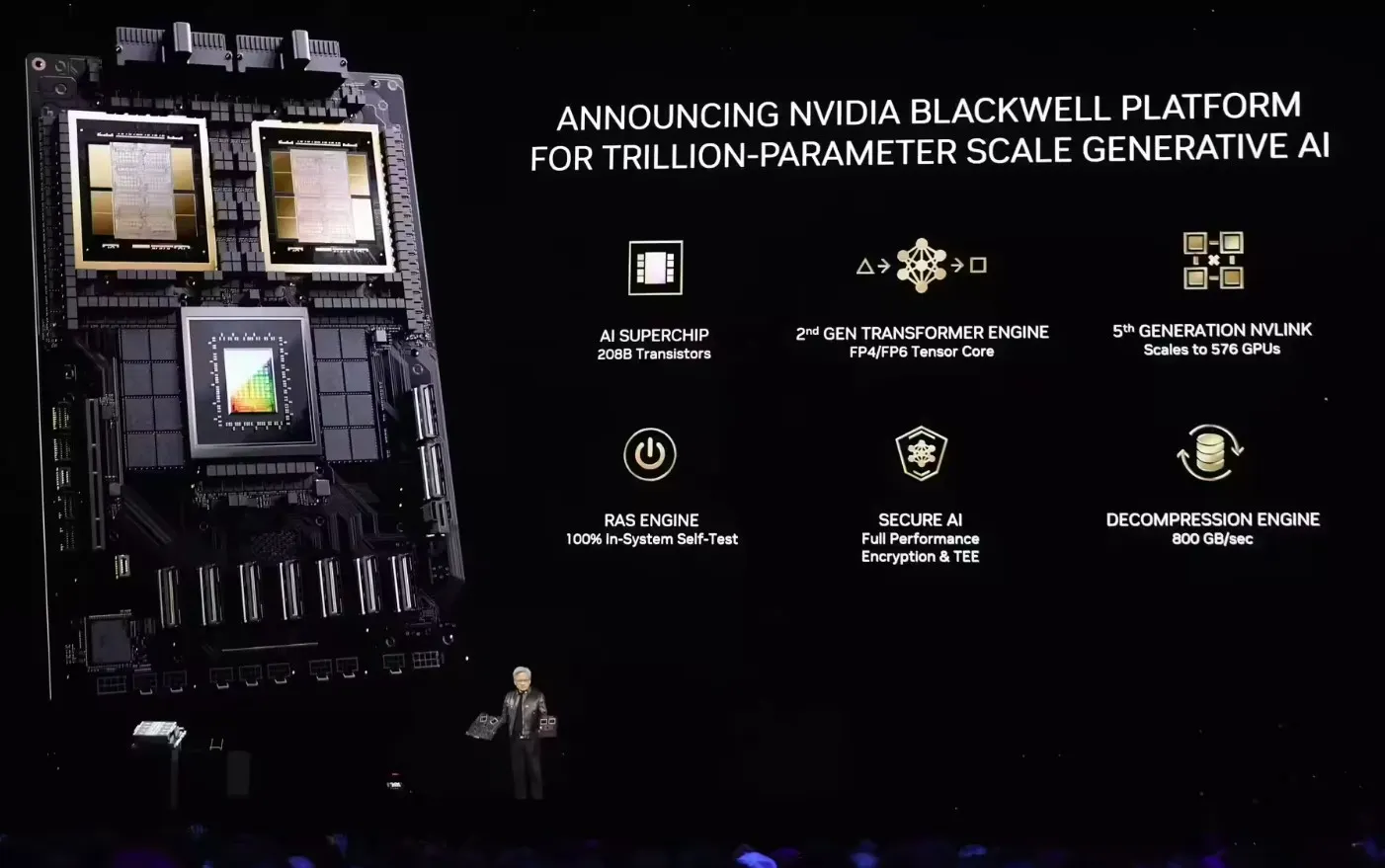
B200 to process a trillion parameter engine
Where Does It Actually Go
The question that my homelab GPU price research kept pulling me back to, once I started looking at the infrastructure scale of this problem, was simple. When a hyperscaler decides that its A100 cluster is economically obsolete and upgrades to Blackwell, where does the A100 go?
I optimistically answer that it enters the secondary market, gets picked up by neo-cloud providers and GPU cloud operators who refurbish and redeploy it for inference workloads where the performance differential over newer hardware does not matter as much, and continues to earn its environmental cost amortised over a longer useful life. There is truth to this, and the secondary GPU market is a real and growing ecosystem that is doing genuinely useful work in extending hardware lifespans that would otherwise be cut short by upgrade cycles driven more by competitive optics than technical necessity.
The realistic answer is more complicated, because secondary markets have absorptive limits, and not every retired accelerator finds a productive second life. The informal e-waste processing ecosystem has a geography, and it includes places like Agbogbloshie in Ghana and Seelampur in Delhi, two of the world’s most significant informal electronics recycling hubs, where the hardware that does not find a buyer in the formal secondary market eventually ends up being processed by hand, often without protective equipment, in conditions that extract residual value from the materials while externalising the health and environmental costs onto the communities doing the work. Seelampur in particular processes a significant volume of India’s electronic waste, and as India’s own data centre and AI infrastructure investment accelerates, the downstream pressure on informal recycling ecosystems like this one is only going to increase, a fact that tends not to appear in the sustainability sections of Indian technology company annual reports.
There is also a hardware-specific concern that makes GPU recycling structurally harder than it should be. If we look to NVIDIA’s CUDA ecosystem which creates a dependency between hardware and the software stack that runs on it, and the combination of firmware locks, licensing terms that technically classify GPU ownership as a licence rather than a sale, and vendor repair restrictions means that the right to repair movement that is slowly gaining ground for consumer laptops faces an even steeper climb when it comes to $40,000 AI accelerators. If one cannot sell what one does not own, the economics of the secondary market don’t stand a chance, and if one cannot repair what one cannot fully access, the life extension possible through repair and refurbishing is foreclosed before it even begins.
The Jevons Paradox Problem
There is a counterargument that comes up reliably in this conversation, which is that newer GPUs are more energy efficient per FLOP, meaning that each unit of useful computation requires less electricity on a modern chip than it did on a legacy one, and that this efficiency gain offsets the environmental cost of the replacement cycle.
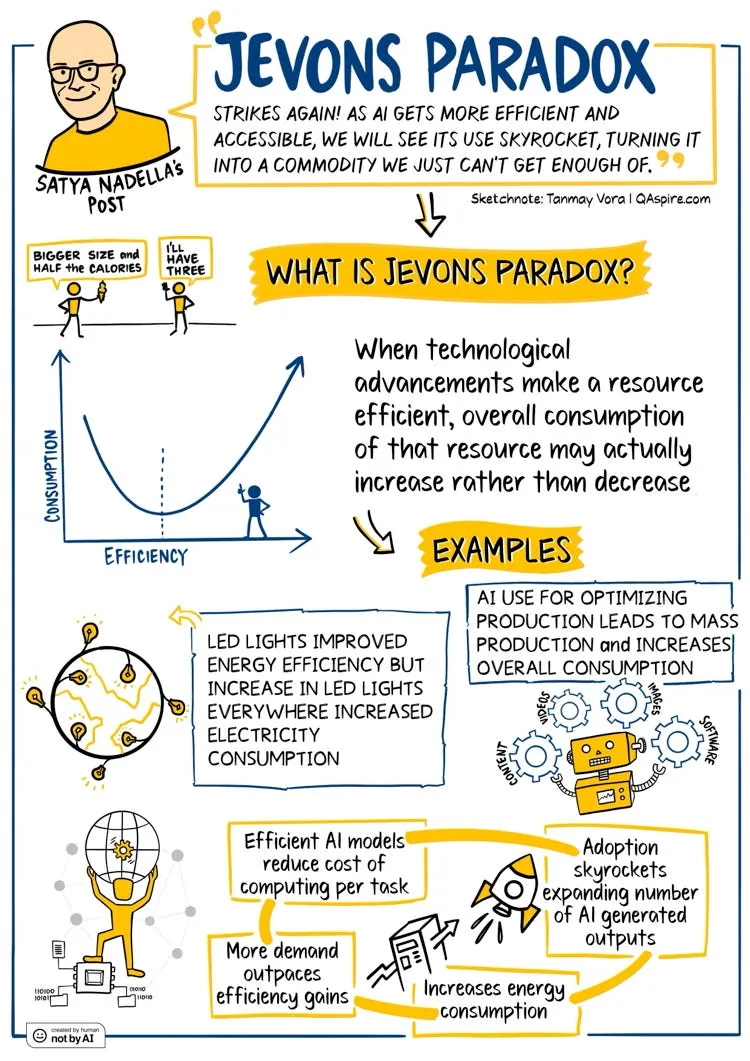
This is true in the narrow sense and misleading in the broader one, because efficiency improvements in AI hardware have historically not reduced total consumption; they have enabled larger models, more frequent inference calls, and expanded deployment at a scale that consumes the efficiency gains and then exceeds them, on and on into a vicious cycle. This is a well-documented phenomenon in economics known as the Jevons Paradox, where improvements in the efficiency of resource use lead to increased rather than decreased total consumption, because efficiency lowers the effective cost and demand responds accordingly.
“The Jevons paradox is an economic principle stating that when technological progress increases the efficiency with which a resource is used, the rate of resource consumption often increases rather than decreases. It challenges the common assumption that higher efficiency automatically leads to conservation.”
The energy efficiency of the H100 over the A100 did not mean that hyperscalers will run the same workloads on less power. It resulted in them running significantly larger workloads, training models that would have been computationally impractical on previous generations, and expanding inference capacity to match growing demand. The GB200’s efficiency gains over the H100 will almost certainly follow the same pattern. Measuring AI’s environmental impact by efficiency per FLOP while the total fleet size and utilisation rate grow rapidly is a bit like measuring the environmental impact of aviation by fuel efficiency per seat while the number of flights increases by an order of magnitude.
What the Conversation Should Actually Be About
The right-to-repair movement, which I wrote about in the context of consumer laptops in my previous piece (you can read that on Medium or Substack), needs to extend its frame of reference to include the infrastructure that AI runs on, because the economics and the environmental logic are the same even if the price tags are different by three orders of magnitude. A $599 MacBook with soldered storage creates e-waste when it retires because the most resource-intensive component cannot be safely separated and recycled. But the $40,000 AI accelerator with firmware locks, licensing restrictions, and vendor repair monopolies ignites the problem to a scale that makes the laptop conversation look like a footnote. O Captain My Captain indeed!
The depreciation conversation that is starting to surface in hyperscaler earnings calls is important not just as a financial story but as an environmental one, because depreciation schedules are a proxy for replacement cycles, and replacement cycles are the mechanism by which functional hardware becomes waste. When Amazon shortens a depreciation schedule from six years to five, based on an accounting decision, that signals the world about how long the hardware is expected to remain in productive use, and the gap between expected useful life vs actual operational lifespan hides the unaccounted environmental cost.
India is in a particularly interesting position in this conversation because it is simultaneously a significant consumer of AI infrastructure, a growing market for refurbished and secondary-market compute, and home to one of the world’s largest informal e-waste processing ecosystems. The policy environment for e-waste in India has improved in recent years but enforcement remains fragmented, and the gap between what the E-Waste Management Rules require on paper and what actually happens to retired enterprise hardware in practice is wide enough to drive a container ship through. As Indian companies and government entities accelerate their AI investments, the question of what responsible hardware lifecycle management looks like in an Indian context is one that somebody needs to be asking loudly, and it is not a question that is going to be answered by importing frameworks designed for European or American regulatory environments.
The AI industry is, at its physical foundation, a mining and materials business that has been very successfully marketed as a software revolution, and the environmental reckoning that comes from treating it primarily as the latter while ignoring the implications of the former is something we are only beginning to see the early edges of. And I must reiterate, we have spent years measuring watts but we forgot to count the waste.
This post is not AI authored. I love to research and write about topics like these, which stemmed from some event in my life. If you like what I wrote, and my style, follow for more random ramblings in the future.